
How To Prepare For Machine Learning Jobs in 2026
Are you scared like other aspiring guys who are preparing for this field? You should be, which is good. Follow this blog, as it’s not at all an AI-generated one. A human like you giving you advice...

READ IT IF YOU ARE SERIOUS ABOUT IT.
As someone who has been teaching people in machine learning and data science-related subjects, I can see fear in my students every day. It’s not because they are dumb; it’s because they are worried about their future.
One thing for sure, for my students or any professionals who are in this field, is “You don’t need to be scared.”
Why?
Think about it. Please don’t read it while using Instagram Reels because it’s full of clown influencers who are giving you advice that makes no sense most of the time. They are the real parasite in your brain. The other day I saw a guy talking about FAANG, MAANG, BIG4 companies and ended up selling courses for some big companies…
I’m not saying they shouldn’t, as that’s their profession, but I’m just making you aware that you should stop following people like them or their roadmaps. People keep posting roadmaps all year just to make you confused. One guy will say,
“Math is secondary; you can ignore it.”
The other one will say:
“Dude, how can you go for interviews without a course certificate?”
You will keep following roadmaps and stuff, and the year will end. And that’s how you will be wasting another year. It’s not just those influencers’ fault. Its fault of yours as well.
What to do then?
Look, I’m not going to write this blog as a longer one but as an effective one, as I want everyone to read this.
First thing first, try to make a habit of sitting in one place and reading. Ok, bro, don’t just read novels. I’m talking about reading books here. Yeah, this is old school. People will find it dumb. I will tell those people
Shut up. Because people who read are going to do great things.
Why? Let me explain.
Reading books, specifically books in the machine learning or AI-related field, will make you smart. You will be speaking well. Your words in a sentence will be so classy when it comes to interviews. Because it matters. ML is a field where you don’t need to be really good at coding like an SDE job or backend job.
What matters the most is understanding data and business. If you have worked with Jupyter Notebook, you must have seen that as a fresher, you are coding one-liners in one cell. Eg:
df[:] = df.loc[:, df.columns.difference([‘ID’])]
This above one line is enough to remove the ID column while preserving the original DataFrame object reference. I mean, look at this; crazy!!
isn’t it?
That’s the power of Python and its libraries. You can just learn coding-related stuff easily. So, what’s there to learn then?
The things that most of these influencers don’t speak about.
UNDERSTANDING BUSINESS
If you are a guy who is starting a career in college trying to learn ML or even someone who is experienced and trying to switch jobs into the AI field, the most important thing is that you should understand the business side of your data.
And how is this going to be improved?
Simply work on different types of data. What I mean by that is pick datasets from different sectors. Read about that sector a bit. Learn what there is to understand. Read the dataset carefully. Don’t just jump into the project and coding in the notebook directly.
That’s stupidity. That’s where your patience to build a project will grow. You will understand things. As we all know, right? “Quality over quantity.” But still we all make the same mistake again and again. Don’t do that this time. Learn and build with patience.
Where to start?
Yes, this is really confusing for many people. But here is the thing. If you are totally into ML field, never ever start anything before Mathematics & Statistics. These 2 are the backbone of ML. Reach out to me on IG or X for math and stat resources for FREE. Once you are complete with this go for Python, SQL & ML basic models.
Never ever skip basic models & jump into the Deep Learning part. It’s needed, guys. These things will give you a lot of confidence; also, it’s something that is going to be asked in interviews. Once you will build some projects in classical machine learning models, jump into Deeep Learning after this.
As I have already told you guys, try making projects which are with new data, extract if you can by yourself.
Make reference projects [Don’t put them on Resume]
Make new ones [Put them on resume]
Projects matter, not your certificates.
How to learn effectively?
As you can see, if you are a fresher, you have so many things to learn to land an ML job. The real question is how should you learn them? There are some common paths. The right one depends on your background, time, and goals.
Open Source & Doing Everything by Yourself I always suggest students not to spend money nowadays on courses if you are a good self-learner. You should be the driver of your own learning path. You must design your own curriculum, stay motivated without deadlines, and actively seek feedback. Networking also becomes your responsibility. You need to attend meetups, contribute to open-source projects, participate in online communities, and reach out to people directly. This path works well for people who are self-driven and comfortable learning independently.
Also can check reference here: https://roadmap.sh/r/ml-engineer-3dqvu
For those who want more structure, Bootcamps and certificate programs are another option [I never suggest this at first place but if its less amount and you are lazy go for it.]. These programs provide clear learning paths, regular deadlines, mentorship, and a peer group. Many bootcamps also bring in industry professionals, which helps ensure that what you’re learning matches real job requirements. The main advantage is speed and accountability. The downside is cost, and the quality varies widely. The best programs have strong job placement records and partnerships with companies. Without that, they often become expensive versions of online courses.
Master’s degree is also an option. A master’s can be useful if you are targeting large tech companies that rely heavily on formal credentials and automated resume screening. I mean, in India you might be seeing a lot of people going to outside countries like US, AUS, CAN, NZ.….However, many programs are heavily theoretical and slow to adapt to changes in industry tools and workflows. The time and financial investment can be significant, especially if you study full-time.
I’m seeing a trend nowadays outside as well where MS students are struggling to get a job. So, the grass is always greener on the other side. Consider all things and then go for it.
Some people also consider PhDs, especially when they hear about cutting-edge AI research. In practice, a PhD is only valuable if you want to work in research or model development. The timeline is long, and the opportunity cost is extremely high. For applied AI engineering roles, this path is usually unnecessary.
So which path makes the most sense? For most AI engineering roles, especially at startups and mid-sized companies, a technical bachelor’s degree combined with strong self-study and real projects is enough. Bootcamps work well for people who already have a technical background and want to move quickly with guidance. Master’s degrees make sense if you are aiming for top-tier companies and can manage the cost without stepping away from work.
Regardless of the path, additional self-learning and project work are unavoidable.
What projects to make?
If you are building projects for yourself or for others, this framework helps you create work that actually stands out. As I already said before, build things that have some value. Not some random projects like “Titanic Dataset.” Ok!! That can be your reference project, but don’t put projects like those on your resume & hope you will get selected for interviews.
1. Start with a real interest
Choose a problem you genuinely care about. Curiosity and domain familiarity show up clearly in your decisions and explanations.
2. Use data that is not obvious
Avoid popular, ready-made datasets. Pull data from APIs, scrape websites, explore government or niche industry sources, or generate your own data through small experiments.
3. Think in systems, not notebooks
Build something end-to-end. Include data ingestion, storage, preprocessing, model usage such as RAG or fine-tuning, deployment, and a simple UI or API. This reflects how real products are built.
4. Add one “production touch.”
Even a small detail like logging, error handling, model evaluation, or monitoring makes your project feel real and professional.
5. Explain your decisions
Document not just what you built, but why you built it that way. Trade-offs, failures, and lessons matter more than perfect results.
6. Package and share intentionally
Create a clean GitHub repo with a clear README and setup steps. Add a demo, screenshots, or a short video. Then share it on LinkedIn, X, blogs, or meetups.
Strong projects tell a story. When your work shows real-world thinking and execution, job applications become a lot easier.
For Freshers Or Switching guys
When you do not have work experience, your resume needs to highlight what you can do. Put your AI skills at the top, make your projects easy to see, & add your portfolio link clearly.
On LinkedIn, avoid titles like “Student” or “Aspiring Data Scientist.” Position yourself by what you are building and working on, not what you hope to become.
This improves your chances, but automated filters can still block you. That is where networking matters.
Ok. One more thing. CONNECTIONS
Connection is not only about attending seminars or seeing resources or asking for referrals. A better approach is thoughtful outreach. Find people working in AI/ML at companies you just have in your list [I hope you have a list of companies in your mind ot noted down somewhere], whether they are hiring or not.
Do your homework. Read their blog posts, watch their talks, or read their papers. Then send a short message appreciating their work and asking a genuine question about a decision they made.
No job talk. No referral ask.
If a conversation starts, you can later ask for feedback on your resume or projects, or learn what skills their team values.
Most people ignore bad messages. But good, personal ones often get replies. The worst case is silence. The best case can change everything.
Want to see example. This is someone asking me for an internship role.
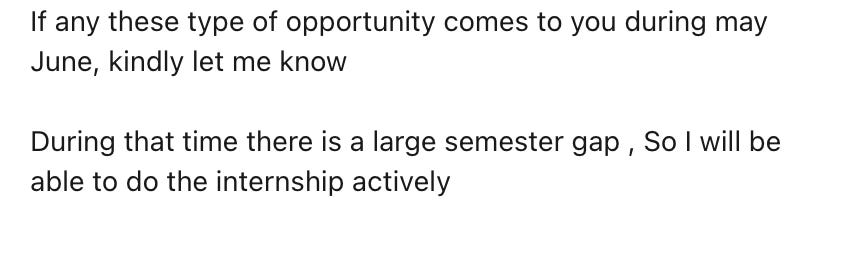
From my Linkedin DM
Hmm. What do you guys think will response to it? I ignored after this text.
Not Advice, But Remember!
AI/ML engineering takes time. Don’t think a 3 months learning period will make you knowledgable enought for an interview. For most people, learning the basics and building simple AI apps takes about 6 months if you already know some programming. If you are starting from scratch, expect closer to a year.
Getting comfortable with advanced concepts usually takes another 6 to 12 months. This is when your projects become more complex and your understanding gets deeper.
Reaching a solid professional level often takes 1 to 2 more years. Senior or lead roles come much later and usually require several years of real-world experience.
This plan is for someone who is patient enough. As per my reading and reports, till 2030 this field is going to demanded like never before. More hiring will happend. It’s just they are not going to hire some regular guys. Be unique and be productive. Be you.
Thanks for reading this blog. Appreciated. Comments and suggestions for apsiring guys are welcome.
Support the author here, If you found this blog helpful.
If you’d like to chat 1:1, you can book a call with me here.
Subscribe to my newsletter for a weekly post on a mix of technical topics and mindset/motivation for challenging fields.
Subscribe to my YouTube channel. Will start uploading long videos soon.
Follow me on socials for more updates, behind-the-scenes work, and personal insights:

 | A guest post by
|
Every focused ML candidate should read this, it cuts through all the noise and scattered educational content on the internet. Actually, not just for ML, but you’ve created a really smooth, comprehensive guide for anyone looking to specialise in data science and AI. Appreciate your work. Respect.
**Stay motivated without deadline** I loved it.
We often see posts like “Learn data science in 6 months.” It may be true for some people.
But when you actually start learning and six months pass, you may find yourself still learning ( The basics ). That can easily become demotivating—especially if you believed you would have mastered data science within that timeframe.
It can feel overwhelming if you strictly hold yourself to the deadlines you see on the internet.
I loved your franchise